Black Ink: Pulp Stories from Black Newspapers, 1929-1955
Edited by Timothy R. Granger and Michael W. Phillips Jr.
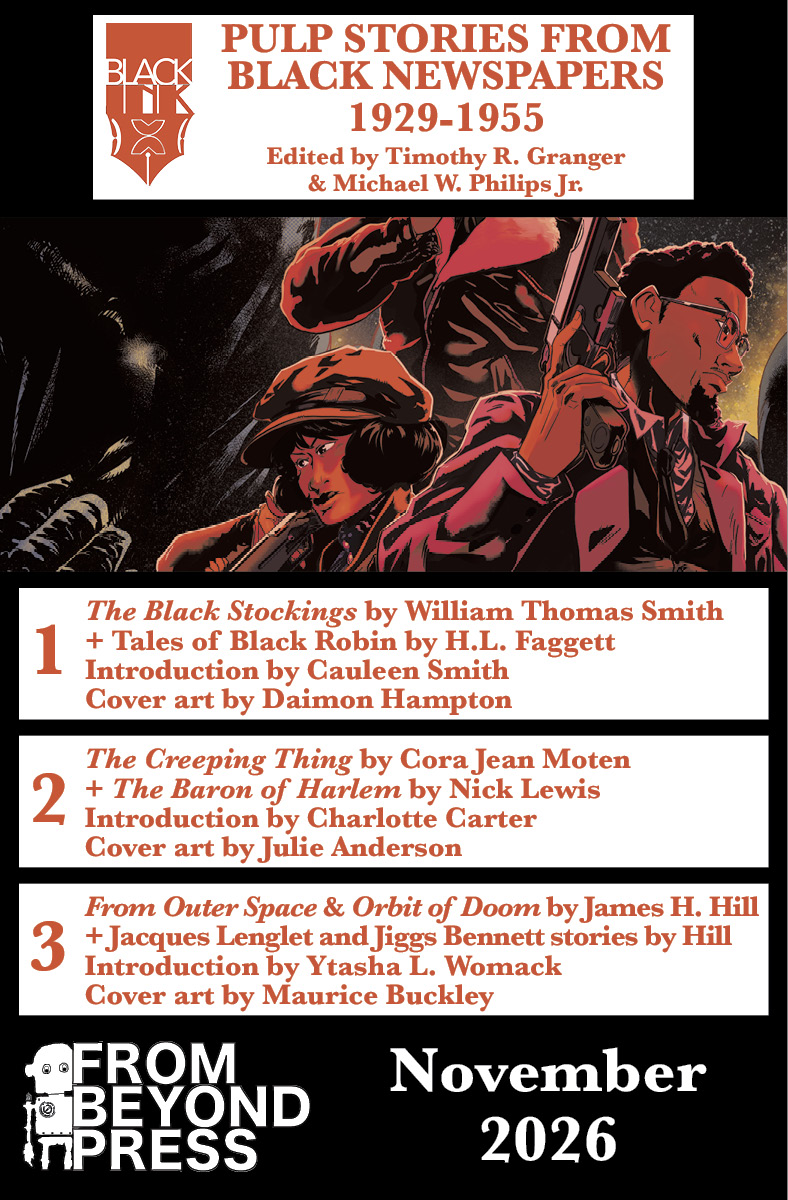
While there may have been few people of color writing for pulp magazines in their heyday of the 1920s through 1950s, that doesn’t mean there weren’t Black writers creating their own tales of science fiction, fantasy, mystery, and horror. Instead of mainstream pulps, they published in Black newspapers that had circulations in the hundreds of thousands. These stories of daring rogues, alien encounters, and future technologies are as exciting as any of the “classic” adventure fiction that continues to be lauded today. With three distinctive anthologies of stories all reprinted for the first time, the Black Ink series is a step toward placing those Black speculative fiction writers into the conversation that has long excluded them.
Volume 1
The Black Stockings (1937) by William Thomas Hill
with “Tales of Black Robin” (1945-1952) by H.L. Faggett
Introduction by Cauleen Smith
Cover art by Daimon Hampton
Although published nearly ninety years ago, William Thomas Smith’s 1937 serial novel The Black Stockings feels ripped from today’s headlines: a white supremacist presidential candidate and his masked terrorist group, the Black Stockings, vow to kick all immigrants and minorities out of the country, and a Black guerrilla network armed with advanced weapons battles against them. In a similar vein, H.L. Faggett’s Tales of Black Robin (1945–1952) detail the adventures of a former football player turned undercover avenger who rights racist wrongs in the Jim Crow South, one punch in the jaw at a time.
Volume 2
The Creeping Thing (1929) by Cora Jean Moten
with The Baron of Harlem (1933) by Nick Lewis
Introduction by Charlotte Carter
Cover art by Julie Anderson
In 1929, shortly after the word “zombie” was introduced to the English language, Black writer Cora Jean Moten wrote one of the first zombie stories in English—and one of the best. The Creeping Thing, serialized in Black newspapers across the country, is a truly terrifying horror-mystery hybrid about a detective investigating a strange series of disappearances in a bizarre southern mansion. This volume also features Nick Lewis’s The Baron of Harlem, a fast-paced gangland tale of warring beer barons, dazzling divas, and a mad scientist who can turn Black men white and white men Black.
Volume 3
From Outer Space and Orbit of Doom (1955) by James H. Hill
with Hill’s Jiggs Bennett and Jacques Lenglet stories
Introduction by Ytasha L. Womack
Cover art by Maurice Buckley
Largely forgotten today, James H. Hill’s “From Outer Space” and “The Orbit of Doom” (1955) encapsulate the growing fears of technological warfare and innovation running rampant in the mid-twentieth century. Serials of warning, these connected stories of flying saucers, espionage, and alien civilizations are as thrilling as they are prescient. Also included in this collection are stories of Jacques Lenglet, a daring Senegalese fighter pilot, and Jiggs Bennett, a savvy New York reporter whose beat always serves to fight injustice. Together, these stories, originally published in the Baltimore Afro-American, showcase Hill as a prolific and forgotten stylist of the pulp tradition.
Introduction bios:
Charlotte Carter is author of three acclaimed crime novels featuring Nanette Hayes, a young Black jazz musician—Rhode Island Red, Coq au Vin, and Drumsticks—which were translated into six languages and reprinted by Penguin/Random House in 2022. Her one-off novel, Walking Bones, published in England, garnered high praise in Europe and in the U.S. The newly published Beauty in the Blood follows the migrating soul and the inescapable fate of a slave girl, taking her from an 1860s plantation to the glamorous life of a New York attorney in the year 2000. Carter is a lifelong devotee of film noir, and a past recipient of the Chester Himes Mystery Writers Award.
Cauleen Smith was raised in Sacramento, California and lives in Los Angeles. Smith is faculty in the UCLA School of Arts and Architecture. Smith holds a BA in Creative Arts from San Francisco State University and an MFA from the University of California, Los Angeles School of Theater Film and Television. Smith is the recipient of numerous grants and awards, including a 2022 Heinz Award; Guggenheim Fellowship; Joyce Alexander Wein Artist Prize; Ellsworth Kelly Award; The Herb Alpert Award in the Arts; and a Rauschenberg Residency. Smithʼs works have been featured in solo exhibitions at institutions such as Los Angeles County Museum of Art, Los Angeles, CA; Whitney Museum of American Art, New York, NY; Institute of Contemporary Art, Philadelphia, PA; San Francisco Museum of Modern Art, San Francisco, CA; Museum of Contemporary Art Chicago, Chicago, IL; Art Institute of Chicago, Chicago, IL; Massachusetts Museum of Contemporary Art, North Adams, MA; Contemporary Arts Museum Houston, Houston, TX; and Carnegie Museum of Art, Pittsburgh, PA, among others. Her work is included in many public collections, such as the Art Institute of Chicago; Los Angeles County Museum of Art; Museum of Contemporary Art, Los Angeles; San Francisco Museum of Modern Art; Studio Museum Harlem; Smithsonian Museum of American Art; and the Whitney Museum of American Art.
Ytasha L. Womack is a critically acclaimed author, filmmaker, dancer, independent scholar, and champion of humanity and the imagination. Her book Afrofuturism: The World of Black Sci Fi & Fantasy Culture (2013), a Locus Award finalist, is the leading primer on the exciting subject that bridges science fiction, futurisms, and culture. Womack tours the world championing Afrofuturism and the role of the imagination. Her works on Afrofuturism have been translated into Portuguese and Spanish for markets in Brazil and Latin America. She is also the author of the Rayla 2212 series and the nonfiction books Spider-Man: Miles Morales (2026) and Black Panther: A Cultural Exploration (2023). Her film A Love Letter to the Ancestors From Chicago (2017), an Afrofuturist dance film, has played in festivals around the world, winning Best Experimental Film at the Collected Voices Festival.
Cover artist bios:
Daimon Hampton is a comic book artist based in Chicago. He has been self-publishing comics since 2012 and was selected to be in DC Comics’s Milestone Initiative in 2022. His titles include Microphone Misfits: Escape From Babylon, Become, The Rose Society, Stellar Remnant, The Archon Experiment, and Story of Solace. Website
Julie Anderson is a Brooklyn-based artist specializing in a storytelling illustrative style. She draws influence from realism, Japanese animation, surrealism, and American comics. She showcased at the Schomburg Center for Research in Black Culture, and was the first Black woman to illustrate a cover for G.I.Joe, A Real American Hero! Julie continues to create art and explore new ways to express her creative vision in different mediums. Instagram
Maurice Buckley is an illustrator and sequential artist. He received a BFA in Studio Art at Alfred University in 2013. Since then, he has worked as a teaching artist in both New York City and Chicago. He currently works and lives in Los Angeles, and vends at conventions whenever he can. Website
Release date: November 11, 2026